
Featured / In Conversation
Vitamin Wig C (Robbie Hansen)
Robbie Hansen talks childhood hearing loss, recording inside tunnels and sea caves, creative limitations, and the world-building philosophy behind Vitamin Wig C.
July 21, 2026 / 10 minute read
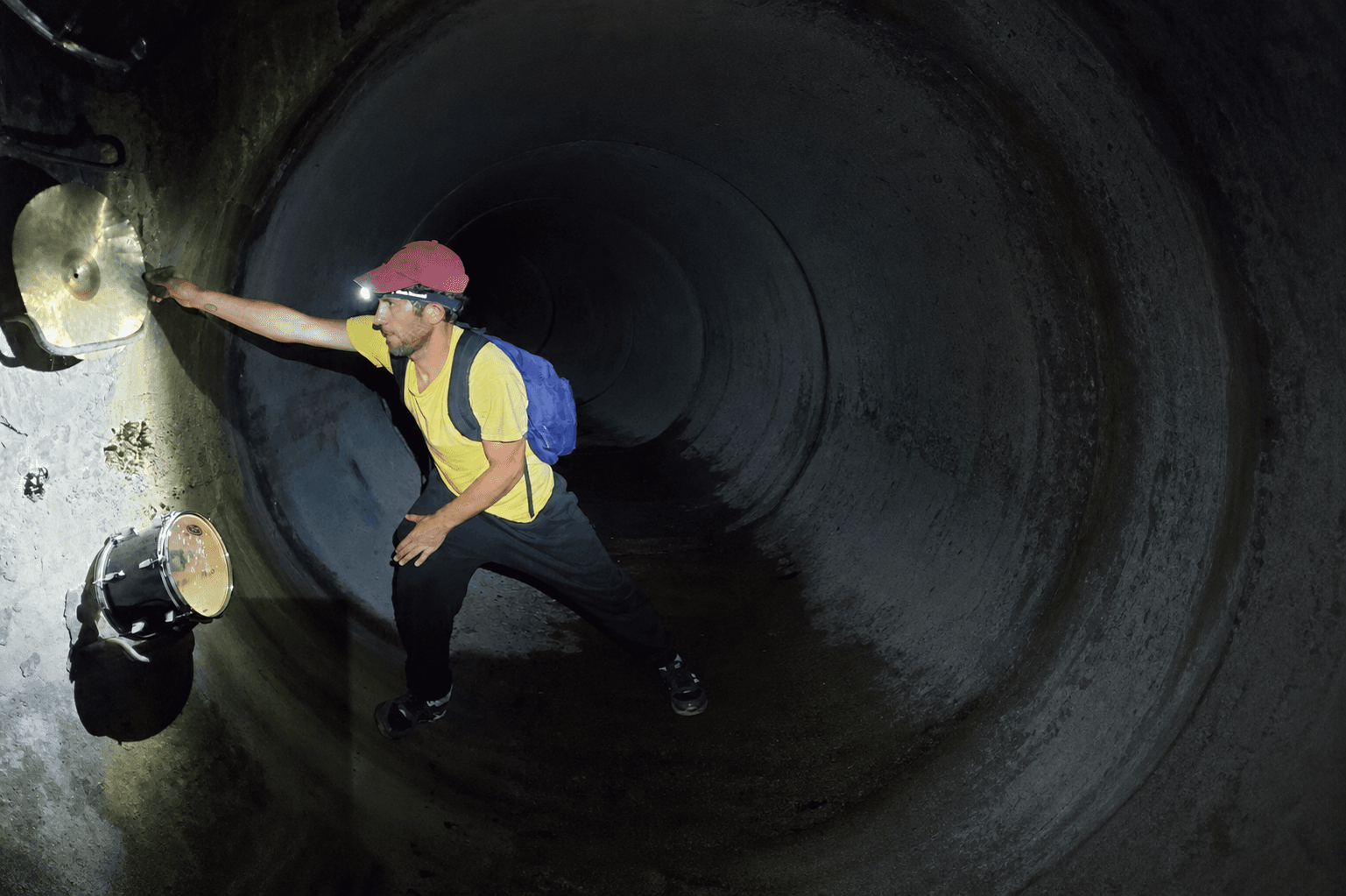
When I first came across Robbie Hansen, I had a hard time pinning him down. His catalog stretches across hundreds of recordings and multiple aliases, touching everything from experimental pop and ambient composition to film scores, jazz, and sound collage. The deeper I dug, the more I realized his work wasn't something you simply listened to—it was something you could get lost in.
After spending almost an hour on the phone with him, that feeling only became stronger.
Robbie is one of the most thoughtful artists I've had the opportunity to speak with. Every answer carried the same curiosity that seems to define his music. Whether discussing childhood hearing loss, recording deep inside California storm drains, embracing creative limitations, or building entire worlds from ordinary environments, it became clear that the music itself is only one piece of a much larger artistic philosophy. What impressed me most wasn't simply the breadth of his work, but the complete sincerity with which he immerses himself in it. There's an unmistakable sense that Robbie doesn't create music to fit into an existing scene or aesthetic; he creates worlds to disappear into, inviting listeners to step inside them alongside him.
We spoke about the origins of Vitamin Wig C, growing up hard of hearing and how it shaped his relationship with music and language, the philosophy behind recording in unconventional spaces, artistic identity, and the value of remaining unapologetically original in an industry that often rewards familiarity. More than anything, I came away fascinated by an artist whose creativity has remained remarkably curious after decades of making music.
Here's my conversation with Robbie Hansen.
SOFT STATIC
How's it going in Argentina?
ROBBIE HANSEN
It's going well. It's a beautiful gray day. Yeah, I woke up this morning, looked at my ceiling, and I said, “That's not the lid of a coffin. This is my ceiling.” Then I rolled out of bed and got some really strong coffee.
SOFT STATIC
You mentioned Argentinian coffee when we were emailing. I've never had it before. Would you recommend it?
ROBBIE HANSEN
It's great. It's a real mood booster.
SOFT STATIC
Noted. Now, I must ask—where did the name Vitamin Wig C come from?
ROBBIE HANSEN
A friend and I were sitting in a studio trying to think of a funny name that captured playfulness and experimentation at the same time—like anything goes. I said, “Vitamin Wig C,” and he said, “That fits,” because you just stuck “wig” between “Vitamin” and “C.” It kind of encapsulates what's going on.
SOFT STATIC
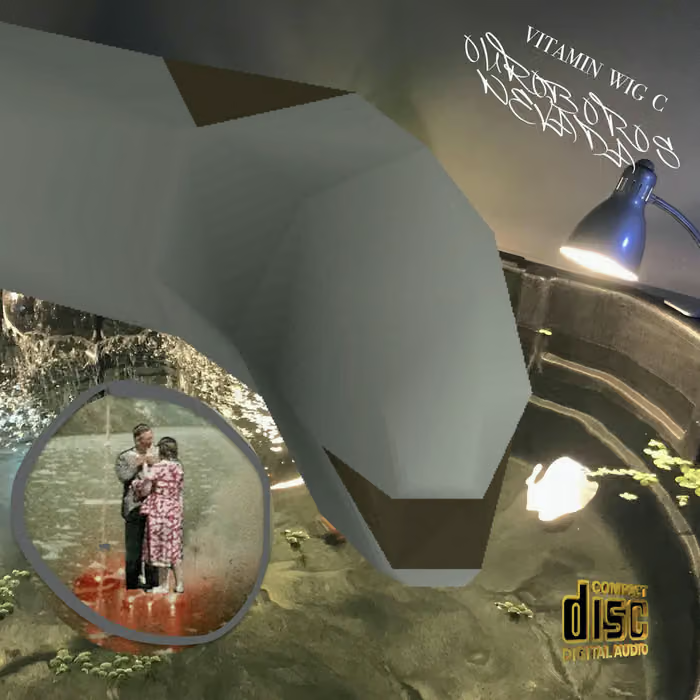
You've built a really distinct visual identity. I was captivated by the artwork for Ouroboros Nevada and a lot of the imagery surrounding your releases. When you make those visuals, do you have a specific meaning in mind, or do you prefer people to develop their own interpretations?
ROBBIE HANSEN
For Ouroboros Nevada it's the idea of the snake eating its own tail. On the album cover, you see the snake deciding not to eat its tail, but instead taking a dip in this strange little pool. Toward the bottom left there's a couple embracing each other. That's from a much older collage I made. The image combines digital manipulation with a small insert from an actual physical collage. It's representative of older artwork where feeling a physicality in the work was important. So it's really a combination of different eras of my artwork.
SOFT STATIC
That openness to interpretation also extends into the way you write. Listening through your music, I couldn't help thinking of Elizabeth Fraser from Cocteau Twins, her vocals often communicate emotion more than literal meaning. Do you relate to that approach?
ROBBIE HANSEN
Fraser has that way of singing where the “words” are purely a melodious prosody. The inflection of her voice says more than any such words could encapsulate. Oh, and Four-Calendar Café is my favorite Cocteau Twins album.
SOFT STATIC
One thing that really stood out while researching your work was your fascination with recording in tunnels and other naturally reverberant spaces. You also mentioned growing up hard of hearing. Do you think that fundamentally changed the way you listen to and appreciate music?
ROBBIE HANSEN
Yeah. I remember waking up in the hospital after ear surgery, and everything sounded masked, almost like pressing a conch shell to your ear and hearing a distant ocean. Eventually that faded, and as my hearing cleared, I became fascinated by acoustics and this network of tunnels coursing a tributary of the Santa Ana River. The tunnels are incredibly deep—you can walk for miles—and the farther in you go, the longer the reverb bleed becomes. I recall my brother and I having fun listening to how sounds would bleed together or, depending on where we were in the tunnel system, create this strange phasing effect mixed with the reverb. I think that early experience really drove my desire to make music that feels spacious.
SOFT STATIC
Earlier you mentioned limitations. Have you ever intentionally imposed limitations on yourself that ended up creating something you never would have made otherwise?
ROBBIE HANSEN
Absolutely. Sometimes the limitation becomes the entire piece. For example, I once recorded inside a sea cave. The composition lasted exactly as long as I could safely remain there. Once the tide started rising, I thought, “Oh shit. I'd better pack up.” That became the duration of the piece.
SOFT STATIC
Your catalog jumps between styles, sometimes even within the same song. Looking back through your discography, do you hear one continuous artist, or a collection of different versions of yourself?
ROBBIE HANSEN
I guess I have the supreme context because every little jump I make in the music or between releases, I can recall where I was, what I was thinking—at least most of the time.
SOFT STATIC
When you're creating, are you thinking about listeners, or is the music primarily for yourself?
ROBBIE HANSEN
Yes and no. When I'm meticulously building something like a pop album, I'm definitely thinking about listeners. Right now I'm working on what you could call a dance album, so I'm asking simple questions like, “Would this actually make someone want to dance?” Other times, no. A lot of the music I make and haven't released was with some intention in trying to make music I could fall asleep to because I was having trouble sleeping. Like medicinal music. Medicinal music for my brain.
SOFT STATIC
If someone wanted to understand Vitamin Wig C through one release, which album would you point them toward?
ROBBIE HANSEN
For me, a defining release as Vitamin Wig C could be Ouroboros Nevada or Dawn Adults. Those were the first records that really drew people in, making me think about reaching the listener beyond my own escapism. Suddenly, I felt seen and heard. It's a tough question, though, because my other aliases have their own defining releases that best capture the project's general ethos. Like with Token Motors, my album Sewer FX really sums up what Token Motors is about without me having to explain it too much. It's implied. When a release can accomplish that, I feel it has achieved its purpose.
SOFT STATIC
A recurring theme throughout your work is originality. You studied jazz piano, and there were countless directions you could have gone musically, but you've built something that feels completely your own. How did you end up making the kind of music you make today?
ROBBIE HANSEN
It started as a series of visions, I guess. When I was around twelve or thirteen, I was in some really hostile environments that I couldn't easily escape. So, the little escapist in me would either go exploring outside, or sit in my room where that escapism would interface as music, drawings, and videos.
SOFT STATIC
It almost sounds like escapism became the creative philosophy behind everything.
ROBBIE HANSEN
Perhaps! I may not think tactically about music the way a lot of musicians do. I've had opportunities to perform music in conventional settings, where I had to come out of my shell. I was fortunate enough to perform at Maybeck Hall—the Kennedy-Nixon House—through a contact living there at the time, which is where my recording Maybeck Hall came from. But generally, I spend most of my time alone building worlds that I can eventually give to other people.
SOFT STATIC
I love that. You mentioned you're working on a new record. Is there anything you can share about it?
ROBBIE HANSEN
Yeah. I have an album right now that's been cooking for almost ten years. It's actually the longest I've ever spent on a record. There are a lot of key players involved, and it's almost finished.
SOFT STATIC
Thank you so much for taking the time to do this today. Before we wrap up, is there anything you'd like readers to leave with? Whether it's something about upcoming music, your philosophy, or simply something you've been thinking about lately.
ROBBIE HANSEN
I think the key to life is knowing when to be a student and knowing when to be a teacher. I call it the student-teacher flip. Stay curious.
SOFT STATIC
I'm looking forward to hearing the new record. Thank you again for taking the time to do this today.
ROBBIE HANSEN
Thank you. I really enjoyed this conversation. If there's ever anything I can clarify after you've put the piece together, I'd be happy to help.
Read Next

Newsletter
Like this kind of thing?
Join the monthly Soft Static email for a quick recap of new pieces and the music still bouncing around our heads.